
September 29, 2026
Robot Photo Booth Glambot
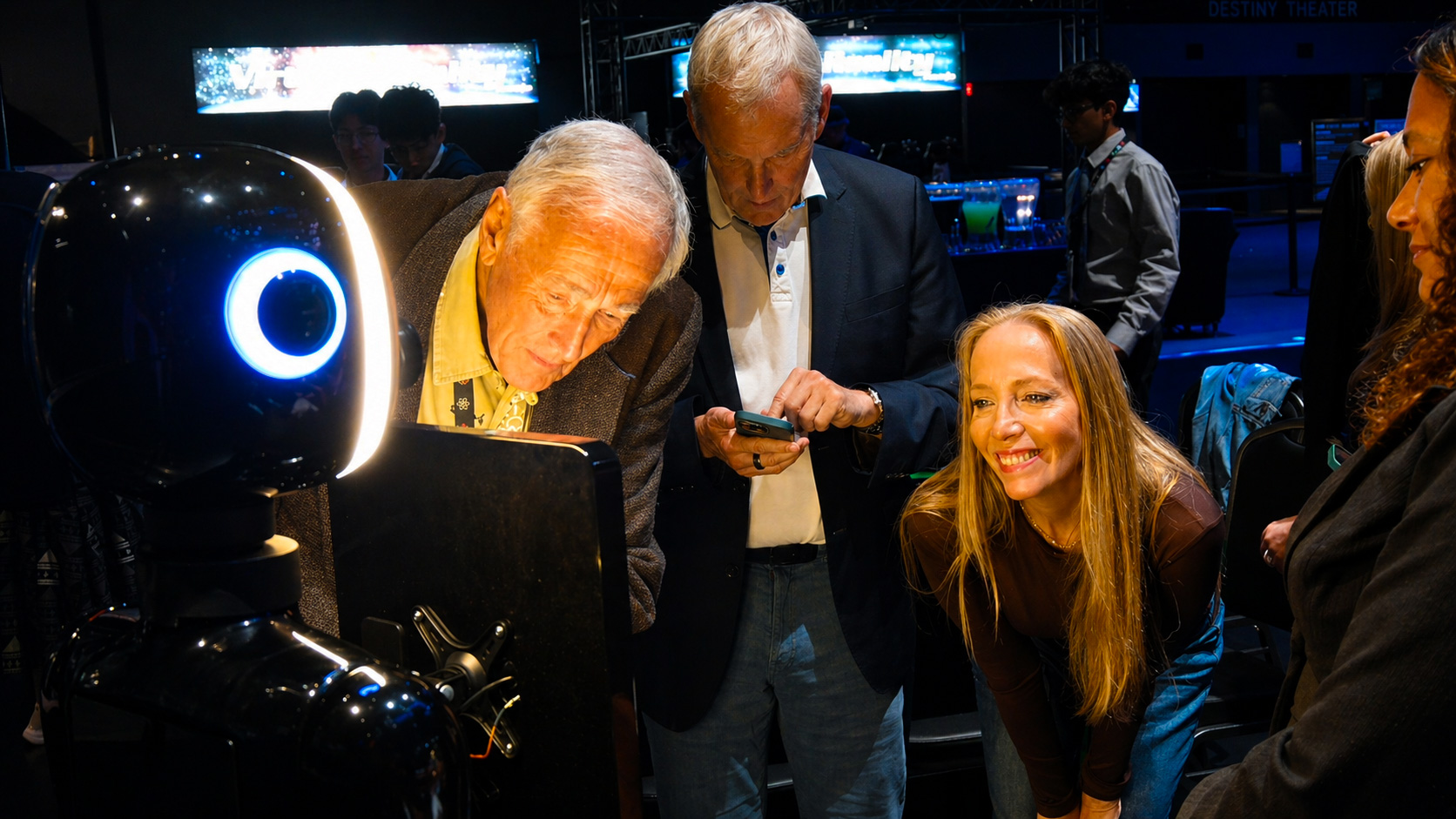
- A robot photo booth is a cinema camera on a programmed motion-control arm.
- The look comes from high frame rate plus a repeatable move, not from the robot.
- It needs roughly 10 × 14 ft, dedicated power, and controlled lighting.
- Throughput is 40–60 guests per hour with a host managing the queue.
- Best on arrivals, red carpets, awards, and launches where entrance is the moment.
Search interest in “robot photo booth” has grown faster than almost any other experience term, and most of the people searching it have seen the output without knowing what produced it. The answer is less exotic and more interesting than the name suggests.
What a robot photo booth is
A robot photo booth — usually called a GlamBot — is a cinema camera mounted on a motion-control arm. The arm executes a programmed move: a sweep, a push in, a rise, an orbit. It runs the same move to the millimetre every time, and it captures at a high frame rate so the footage can be slowed down without losing sharpness.
The robot is not the point. The robot is how you get a repeatable camera move, which is what separates this from an operator with a gimbal. Repeatability means every guest gets the same considered shot, which means the whole night cuts together as one piece of content instead of forty unrelated clips.
Why the footage looks expensive
Three things, in order of importance:
- Frame rate. Captured well above playback rate, so slowing it down yields genuine slow motion rather than software interpolation. The difference is immediately visible — interpolated footage has a soft, smeared quality around moving hands and hair.
- The move. A designed camera path with acceleration and deceleration reads as cinema. A constant-speed pan reads as surveillance.
- Lighting. Because the camera moves through a known path, the lighting can be built for that exact path. This is the part that cannot be faked, and it is why the same rig produces stunning footage at one event and flat footage at another.
The robot buys repeatability. The lighting buys the look.
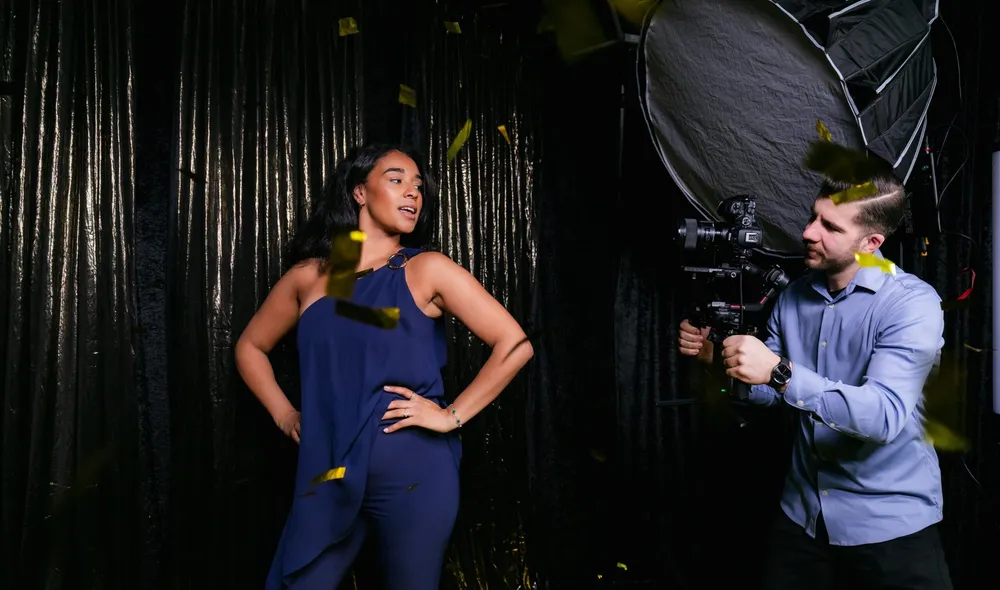
A motion-control arm running a programmed move at high frame rate. Every guest gets the same considered shot.
What it needs on site
- Footprint: roughly 10 × 14 ft clear. The arm needs its travel path plus safe clearance. Less vertical space than a 360 booth, because the sweep is largely horizontal.
- Controlled lighting. This is a requirement, not an upsell. A robot arm in a room lit only by uplighting and a disco wash produces footage nobody uses.
- Dedicated power. One clean circuit for the rig and its lighting.
- A host, not just an operator. Guests need a two-sentence brief before they step in — where to look, what to do with their hands, when the move starts. Without it you get thirty clips of people looking at the camera in confusion.
- A backdrop or a controlled background. The camera moves, so everything behind the guest moves through frame. A cluttered background sabotages the shot in a way it would not in a still photograph.
Expect throughput of 40–60 guests an hour with a host working the queue.
Which events it suits
A robot arm earns its cost when arrival is the moment:
- Awards nights and galas — the red carpet arrival is already the ritual; this makes it a deliverable.
- Product launches — the content is the campaign, and this format is built for vertical video.
- Premieres and openings — guests dressed for the occasion, expecting to be photographed.
- Brand activations with a talent or influencer component — people who know how to use a camera move will use it.
- Conference VIP receptions — small, high-value audiences where the per-guest cost is justified.
It is a poor fit for casual daytime events, kids’ programming, or any room where guests are moving through quickly and are not dressed for the shot.
GlamBot vs. 360 booth
They get compared constantly because both produce short branded video. The differences that actually decide it:
- Vertical space. A 360 booth needs 10 ft of ceiling. A GlamBot does not. In older Houston venues this alone often decides it.
- Accessibility. A 360 booth requires stepping up onto a platform. A GlamBot does not, which matters for formal and mixed-mobility audiences.
- Throughput. GlamBot is meaningfully faster — 40–60 an hour against 25–40.
- Look. The 360 clip is playful and orbital. The GlamBot clip is cinematic and editorial. Match it to the event’s register, not to whichever is newer.
For a black-tie gala in a ballroom with a 9 ft ceiling, this is not a close call. See the full 360 booth guide for the other side of the comparison.
How to brief one properly
Four things to specify, and they take five minutes:
- The move. Ask what camera move will run and why it suits your event. A vendor who cannot describe it is running a default.
- The background. Decide it early. It is in every frame of every clip.
- Delivery timing. Same-night delivery while guests are still at the event drives dramatically more sharing than a next-day gallery. It costs more because it means an editor on site. Decide whether you want it.
- Aspect ratio and branding. Confirm vertical for social, and confirm the lower-third or frame treatment matches the client’s brand rather than the vendor’s.
Snapix has run robot-arm capture at programs including four consecutive years with SpaceX and five years as preferred vendor at Space Center Houston. See our work, browse the experience catalogue, or tell us about your event.