
September 29, 2026
360 Photo Booth
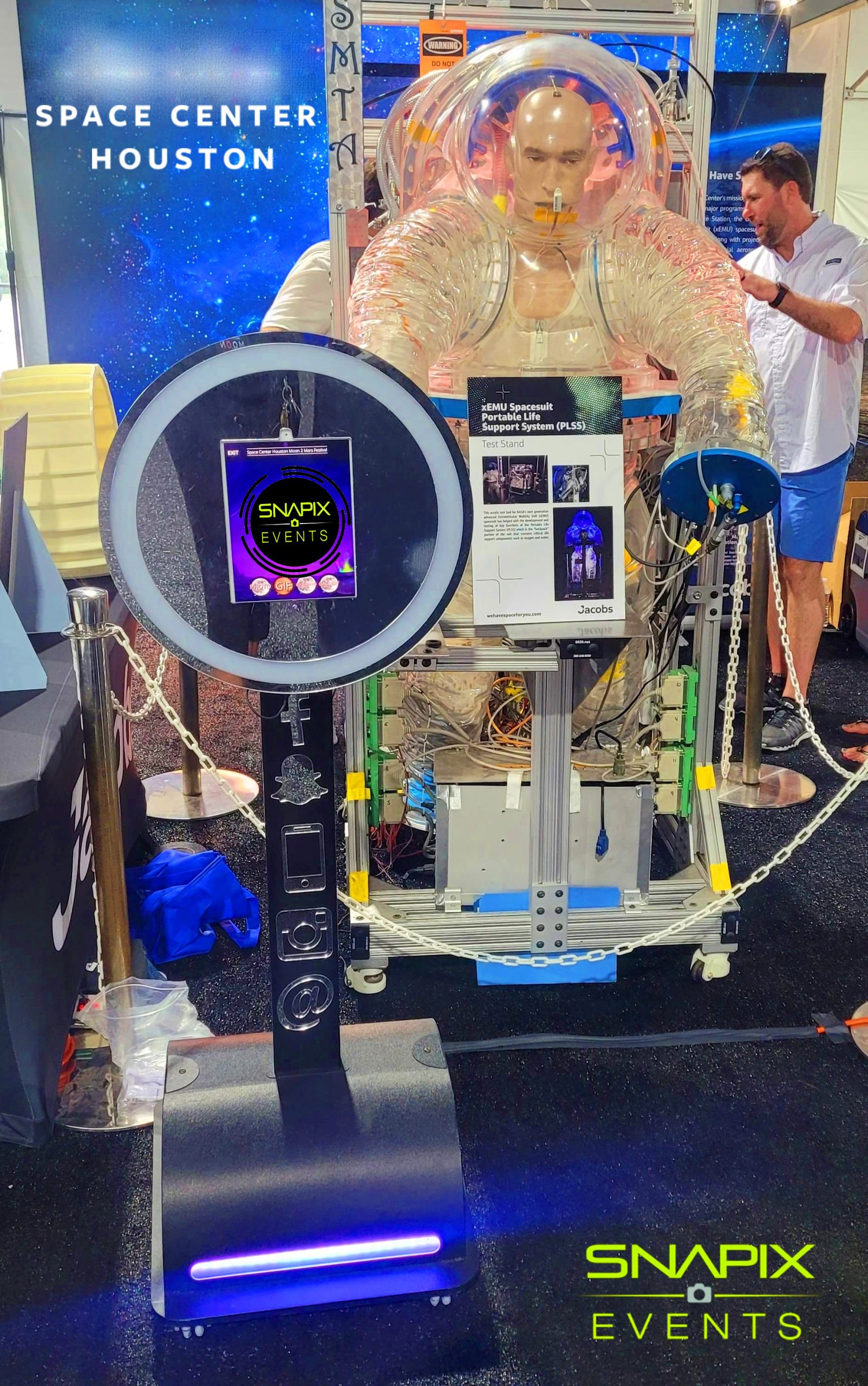
- A 360 booth is a rotating camera arm around a raised platform, not a booth.
- Budget a 12 × 12 ft clear footprint and at least 10 ft of ceiling.
- Realistic throughput is 25–40 guests per hour — far lower than a traditional booth.
- Without dedicated lighting the footage looks amateur, regardless of the camera.
- Houston pricing runs roughly $1,200–$2,200 for two to four hours, depending on branding and staffing.
The 360 booth is the most requested and most frequently mis-specified experience in the Houston market. Planners ask for it by name, then discover on load-in day that the room cannot take it. Almost all of that is avoidable with four numbers known in advance.
What a 360 booth actually is
Despite the name, there is no booth. A 360 photo booth is a raised platform with a motorised arm that carries a camera in a full circle around whoever is standing on it. Guests hold a pose, the arm sweeps, and the result is a short orbiting video clip that gets slowed down, colour-graded, and branded before it is delivered.
That distinction matters because everything difficult about a 360 booth comes from the arm, not the camera. It is a moving mechanical object at head height in a room full of people holding drinks.
Space, ceiling height and power
Four numbers to confirm with the venue before you sell the idea to a client:
- Footprint: 12 × 12 ft clear. The platform is only 3–4 ft across, but the arm sweeps well beyond it and guests need clearance outside the sweep. Squeeze it and you get an attendant spending the night pulling people back.
- Ceiling: 10 ft minimum. This is the constraint that kills the most bookings. Historic Houston venues, tented spaces with sloping sides, hotel pre-function areas with soffits, and any room with low rigging or chandeliers over the intended position are all frequent disqualifications.
- Power: one dedicated 15A circuit. Shared with a coffee station or a band’s backline, you will trip it. Ask for a dedicated drop in writing.
- Load-in path. The platform and arm travel as cased freight. Confirm service elevator dimensions and whether there is a loading dock, because a 360 rig does not go up a passenger lift or a spiral stair.
Ceiling height rules out more 360 bookings in Houston than budget does.
Throughput: the number that ruins events
Here is the trade-off nobody mentions in the sales conversation. A traditional photo booth will move 80–120 guests an hour. A 360 booth moves 25 to 40.
Each capture is 30–60 seconds once you include a guest stepping up, being positioned, the sweep itself, and stepping down. Groups take longer. That is a hard ceiling set by physics, not by staffing.
Which means: at a 400-person event, a single 360 booth running for three hours will reach maybe 30% of the room. If the client’s expectation is “everyone gets one,” you have three options — run a second experience alongside it, extend the hours, or reset the expectation now rather than at 9pm. The third is cheapest and the most rarely done.
Lighting is the whole game
The single biggest quality difference between a 360 clip that a guest posts and one they delete is lighting, and it has almost nothing to do with the camera.
The arm is moving, so the light has to be even through the entire sweep. Rely on the room and you get a clip that is bright on one side, muddy on the other, and colour-shifted wherever it passes a coloured wash from the event’s own lighting design. Continuous lighting mounted to the rig, balanced against the room’s colour temperature, is what makes the footage look intentional.
When you are comparing 360 quotes, this is the line item worth interrogating. A cheap quote almost always means available light.
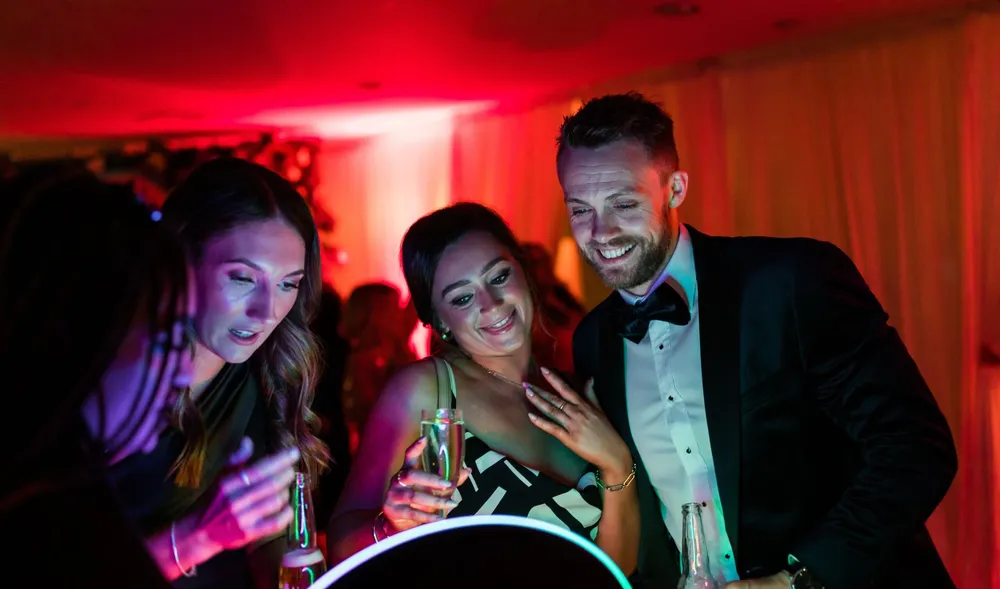
Platform, arm, and dedicated continuous lighting. The lighting is the difference between footage guests post and footage they delete.
What it costs in Houston
A 360 booth rental in the Houston market generally runs $1,200–$2,200 for two to four hours. What moves the number:
- Custom branding on the overlay, platform wrap, and delivery screen
- Dedicated lighting design versus a stock light on the rig
- Staffing level — one attendant versus an attendant plus a queue host
- Same-night editing and delivery versus next-day
- Travel outside the Houston metro to Austin, Dallas–Fort Worth or San Antonio
For corporate programs it usually appears inside a larger activation scope rather than as a standalone rental, because the 360 clip is one content format among several the marketing team wants from the night.
When a 360 booth is the wrong call
Be willing to say no to it in five situations:
- Ceilings under 10 ft. Not negotiable. Specify a GlamBot or vogue experience instead — both produce comparable content in a fraction of the vertical space.
- Large rooms with a short window. If the objective is broad reach in 90 minutes, throughput makes it the wrong tool.
- Formal seated galas. A raised platform in evening wear is an accessibility and dignity problem before it is anything else.
- Older or mixed-mobility audiences. Stepping up onto a platform excludes part of the room. That is a poor look for a client trying to be inclusive.
- No dedicated power. Nobody remembers a great clip. Everybody remembers the breaker going at 9pm.
Snapix runs 360 experiences across Houston, Austin, Dallas–Fort Worth and San Antonio, and will tell you when your room cannot take one. Send the venue name and we will check the ceiling and load-in before you quote it. See the full experience catalogue or start a conversation.